Nine Caching Licences, Three Years: The Cheapest in 2026 Is Fourth by 2029
Updated October 2026
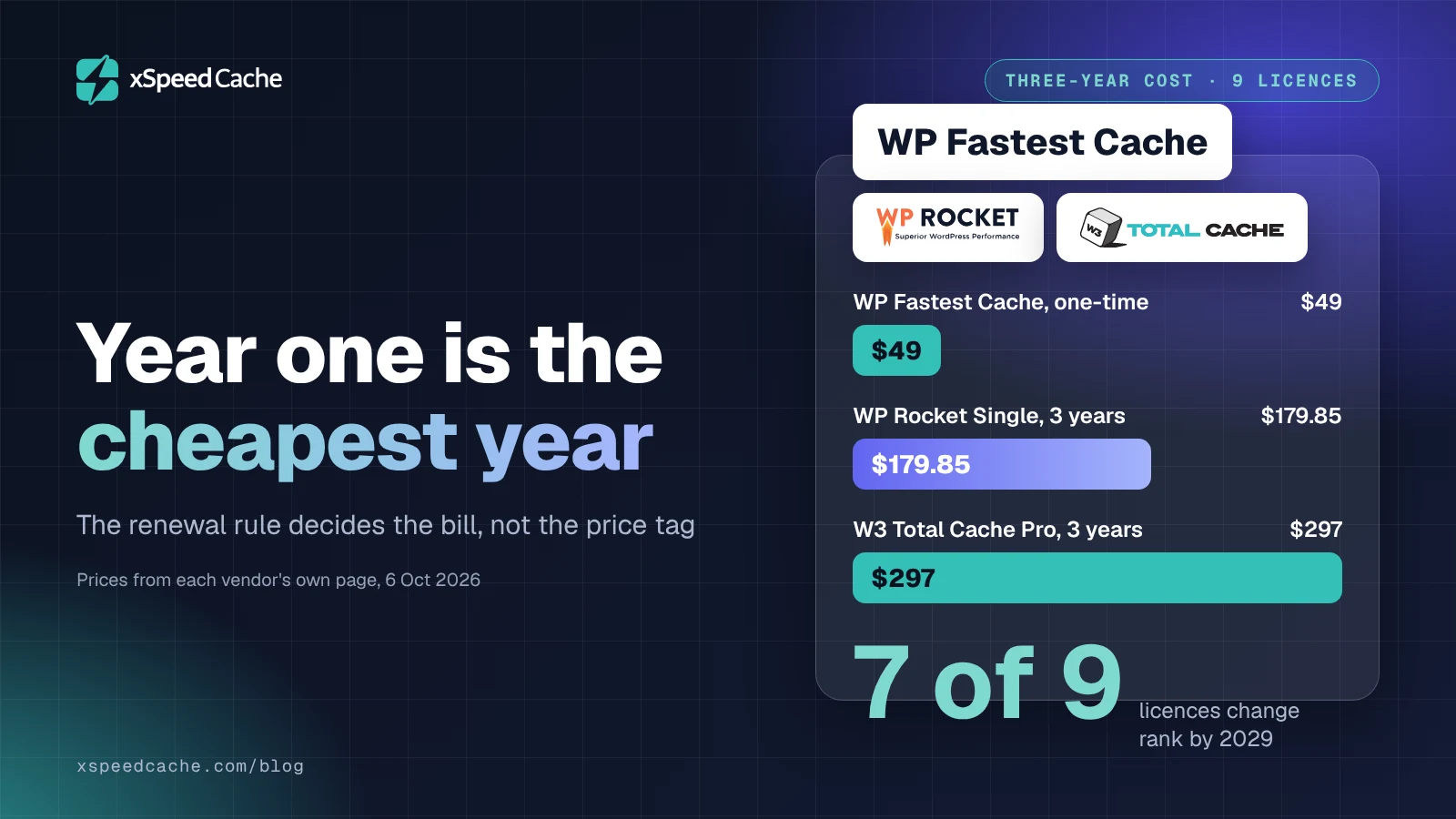
WP Fastest Cache sells a page cache for $49 once, read from its homepage on 6 October 2026. W3 Total Cache Pro charges $99 a year for the same one site, read from its pricing page the same morning. Over three years that is $49 against $297, and neither number appears on the other’s page. The comparison people expect is a ladder of first-year prices. The more useful comparison is what each licence does in year two, because that rule is published somewhere other than the price, or not published at all. This piece prices nine paid licences to 2029 using only figures each vendor publishes.
Quick Summary: What Three Years Actually Costs
| If you want… | Do this | Why |
|---|---|---|
| The lowest three-year bill on one site | WP Fastest Cache Bronze, $49 once | A one-time fee has no year two. Nothing else here is cheaper by 2029. |
| A page cache for nothing, forever | WP Super Cache, Cache Enabler or Breeze | Three of the eleven plugins checked page-cache on any host with no paid tier. |
| Renewals that get cheaper instead of dearer | Perfmatters, $29.95 then $25.46 | The only vendor here publishing a renewal discount, at 15%. It is not a page cache. |
| A single payment that covers 25 sites | our Agency lifetime licence, $249 | $3.32 per site per year across three years, and we built it. |
| To know the year-two price before you buy | Ask the vendor in writing | Five of the ten pages checked give no year-two figure, and three never mention renewal. |
Two things to settle before the table. These are list and launch prices as published on 6 October 2026, for one site, excluding tax. And a licence is not a cache: six of the eleven plugins checked have no paid tier at all, which is where the free field belongs in this decision.
The Price on the Page Is the Year-One Price
Every pricing page in this field is built the same way. Tiers run left to right by site count, each one carrying a single figure and a billing word. The figure is accurate. It describes one year.
What happens next is governed by a rule that lives in four different places depending on the vendor: the tier card, the FAQ below the ladder, a separate refund-policy page, or nowhere. Perfmatters’ FAQ states, verbatim, “there is a 15% discount automatically applied to all renewals.” That sentence sits in the FAQ below the ladder rather than on the tier card it modifies. WP Rocket’s pricing page, fetched the same morning, contains the word “renew” nowhere in its HTML at all.
So a buyer comparing $59.95 against $49 is comparing a number that repeats against a number that does not, and the pages give no help in telling which is which.
The Renewal-Rule Census: Reading Year Two Off Ten Pricing Pages
Here is the framework this article exists for, and it takes one pass over each vendor’s own page. For every licence you are considering, answer four questions in this order, and stop at the first one you cannot answer from published text.
1. Does the price repeat? One-time, annual or metered. The billing word next to the figure answers this and it is the only one of the four that is always published.
2. At what price does it repeat? Promotional pricing and renewal pricing are different numbers. This is the question the pages answer worst.
3. What else is metered inside the tier? Pageviews, CDN bandwidth, image credits, configuration services. A licence can be flat while the thing it licenses is not.
4. What stops working if you stop paying? A plugin that disables itself and a plugin that stops updating produce the same invoice and very different year fours.
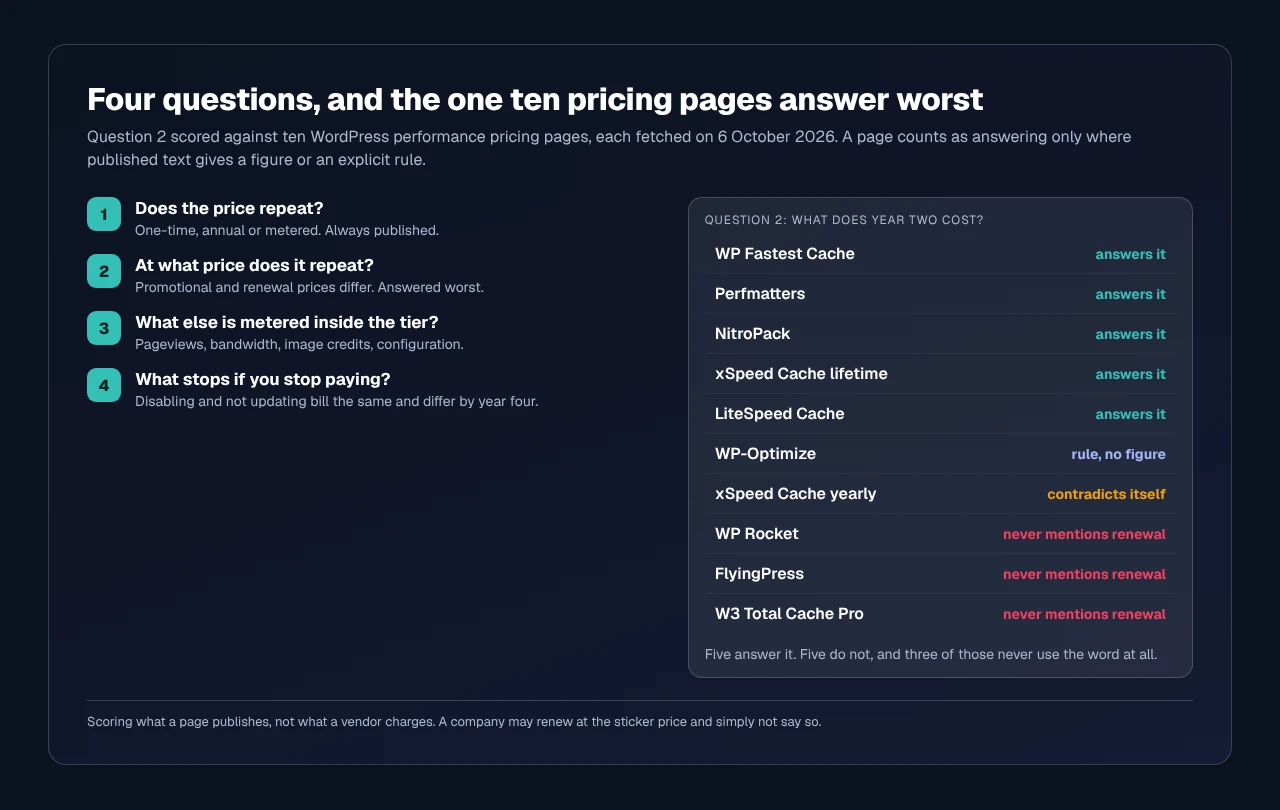
Scored against ten pricing pages fetched on 6 October 2026, the answers come out like this. A page “states” year two only where published text gives a figure or an explicit rule, not where it can be inferred.
| Vendor | Price repeats | Year-two price stated | What else is metered | Published on |
|---|---|---|---|---|
| WP Fastest Cache | No, “One-Time Fee” | ✅ | 10,000 image credits per licence | Homepage |
| Perfmatters | Yearly, auto-renew | ✅ 15% lower | — | Pricing page FAQ |
| NitroPack | Monthly or annual | ✅ | Pageviews and CDN bandwidth per tier | Pricing page |
| WP-Optimize | Yearly, auto-renew | ❌ rule only | — | Refund terms |
| xSpeed Cache yearly | Yearly | ❌ contradicted | — | Card and FAQ disagree |
| xSpeed Cache lifetime | No, one payment | ✅ | — | Pricing page |
| WP Rocket | Yearly | ❌ | RocketCDN beyond 3 key pages | Not stated |
| FlyingPress | Yearly | ❌ | FlyingCDN per domain | Not stated |
| W3 Total Cache Pro | Yearly | ❌ | Plugin Configuration, $125 each | Not stated |
| LiteSpeed Cache | Free plugin | ✅ | QUIC.cloud credits off LiteSpeed hosting | Plugin readme |
What this census cannot tell you. It scores what a pricing page publishes, not what a vendor charges. Four of these companies may renew at exactly the sticker price and simply not say so, and support emails are not public documents. It also reads one page per vendor on one morning; two of the ten have changed inside the last four days, and one of those changes is in the next section. Treat the census as a map of what is knowable before purchase, which is the only information a buyer actually has.
Three Years, One Site, Every Figure From a Vendor’s Own Page
| Licence | Model | Year 1 | Year 2 | Year 3 | Three-year total |
|---|---|---|---|---|---|
| WP Fastest Cache Bronze | One-time | $49.00 | $0 | $0 | $49.00 |
| xSpeed Cache Personal, lifetime | One-time, launch | $79.00 | $0 | $0 | $79.00 |
| Perfmatters 1 site | Yearly, 15% off renewals | $29.95 | $25.46 | $25.46 | $80.87 |
| xSpeed Cache Personal, yearly | Yearly, launch then list | $29.00 | $58.00 | $58.00 | $145.00 |
| WP-Optimize Starter | Yearly | $49.00 | $49.00 | $49.00 | $147.00 |
| FlyingPress Starter | Yearly | $59.00 | $59.00 | $59.00 | $177.00 |
| WP Rocket Single | Yearly | $59.95 | $59.95 | $59.95 | $179.85 |
| NitroPack Starter | Metered, billed annually | $84.00 | $84.00 | $84.00 | $252.00 |
| W3 Total Cache Pro 1 site | Yearly | $99.00 | $99.00 | $99.00 | $297.00 |
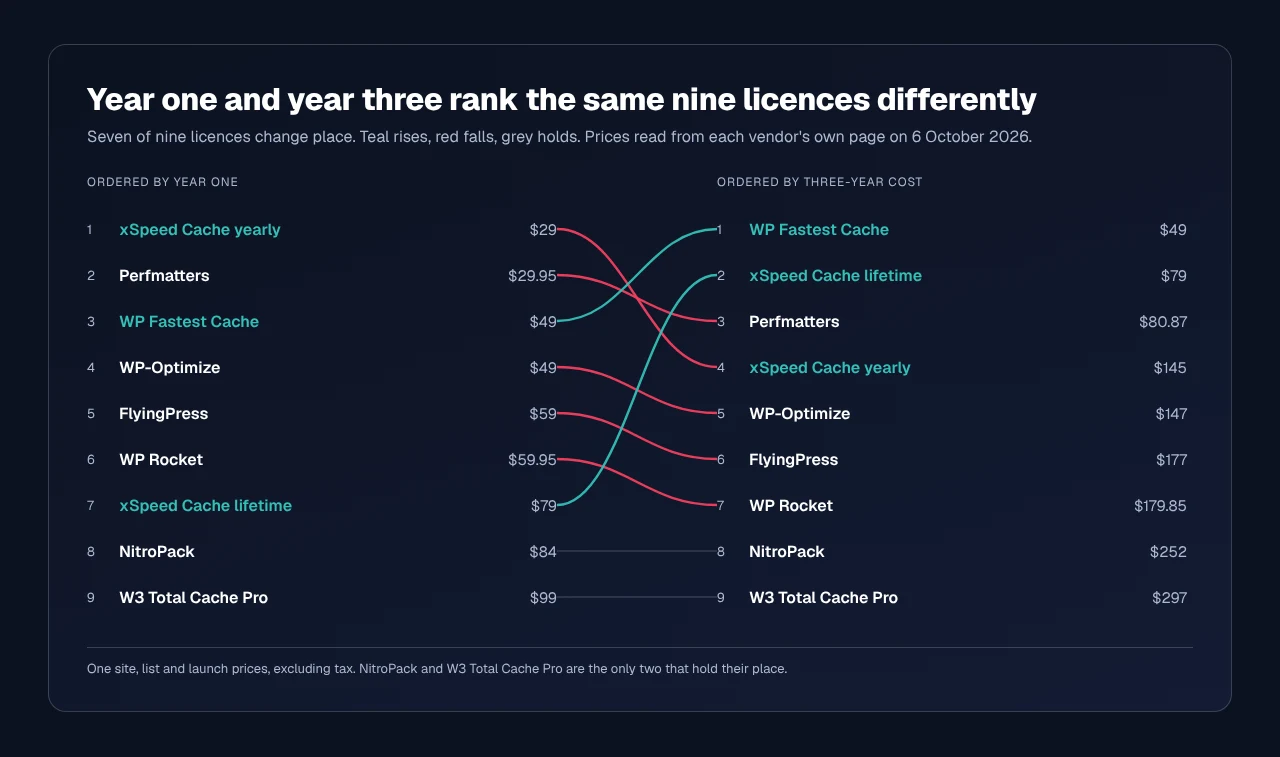
Order that column by year one instead and seven of the nine licences change places. The cheapest first-year price on the board belongs to our own yearly plan at $29, and it finishes fourth. WP Fastest Cache starts joint third and finishes first. Our lifetime licence starts seventh and finishes second, which is the largest move in the table.
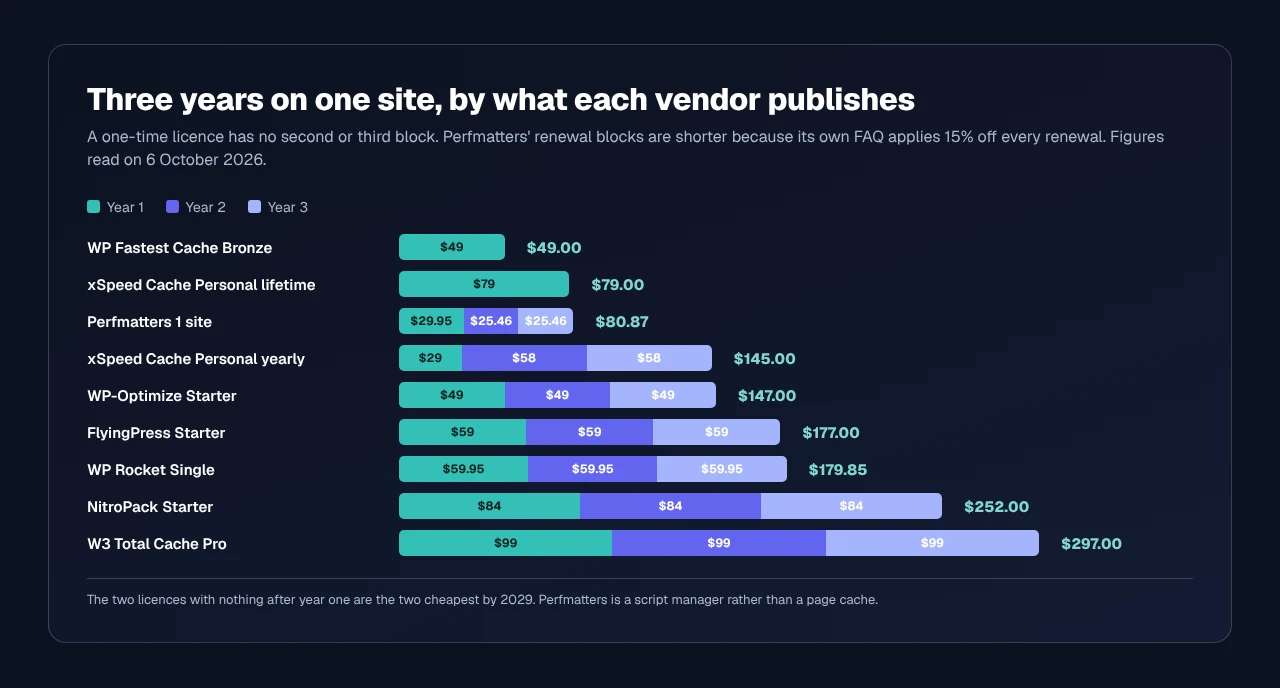
Two rows need their caveats carried with them. Perfmatters is not a page cache, which its own documentation and ours both say; it earns a place here because it is the only vendor in the field publishing a renewal discount, not because it substitutes for a cache. And NitroPack’s $84 is the annual-billing price of $7.00 a month, against $8.00 billed monthly, with “Save up to 18%” printed on the toggle.
The Two Licences That Charge Nothing After Year One
WP Fastest Cache prints “One-Time Fee” on all four of its packages, next to “1 year license transfer right” and a 30 Day Money Back Guarantee. Bronze is $49 for one licence, Silver $125 for three, Gold $175 for five, Platinum $300 for ten, all on the homepage rather than the premium page. Its homepage also claims use on “over 1,500,000 websites” while the plugin directory reports a 1,000,000+ bucket, so the two first-party figures disagree by a bucket boundary.
Our own lifetime tier is the other one. A single payment, and the pricing page states it twice: “One-time payment · no yearly renewal” on the toggle and “One payment, then updates and support with no yearly renewal and no second invoice” in the FAQ. Launch prices are $79 for one site, $149 for five, $249 for 25 and $399 for unlimited. We build xSpeed Cache, and the disclosure belongs in the same sentence as the recommendation: it is the only lifetime licence published in this field, which is why it wins a three-year table, and that advantage disappears entirely at year one.
Those are the only two one-time licences published in this field, so they are the only pair where three-year cost per site can be read straight off the purchase price.
| One-time licence | Sites | Price once | Cost per site per year over three years |
|---|---|---|---|
| WP Fastest Cache Bronze | 1 | $49.00 | $16.33 |
| WP Fastest Cache Silver | 3 | $125.00 | $13.89 |
| WP Fastest Cache Gold | 5 | $175.00 | $11.67 |
| WP Fastest Cache Platinum | 10 | $300.00 | $10.00 |
| our Personal lifetime | 1 | $79.00 | $26.33 |
| our Business lifetime | 5 | $149.00 | $9.93 |
| our Agency lifetime | 25 | $249.00 | $3.32 |
| our Enterprise lifetime | Unlimited | $399.00 | — |
WP Fastest Cache is the cheaper of the two at one site by $10 a year, and the order reverses from five sites upward. Publishing both halves of that is the point: a reader buying for a single site should buy Bronze, and a reader buying for five or more gets a lower three-year figure from us.
A one-time licence buys a third thing that neither table column shows, which is the end of the decision. There is no renewal date to diary, no card to update and no year in which the price can move.
What it does not buy is indefinite portability, and WP Fastest Cache is specific about that on the same card as the price. Each package lists a “1 year license transfer right” beside the one-time fee, so moving a licence between domains is the part of the purchase that does expire. The 10,000 image credits per licence work the same way: they are a quantity rather than a subscription, and a site that runs through them is buying more rather than renewing anything. Neither detail changes the three-year total, and both decide whether that total describes the site you will actually be running in 2029.
The One Vendor Whose Renewals Get Cheaper
Perfmatters’ pricing page carries this exchange under the ladder:
Is there a renewal discount? Yes, there is a 15% discount automatically applied to all renewals.
Applied to the published $29.95, $59.95 and $124.95 tiers, renewals land at $25.46, $50.96 and $106.21. Over three years the unlimited-sites tier costs $337.37 rather than the $374.85 a flat reading of the page would predict, a difference of $37.48 that exists only because one FAQ answer was read.
No other vendor in this census publishes a renewal figure of any kind. Three never mention renewal at all, and WP-Optimize publishes the mechanism without the number: per its refund terms, “Subscriptions renew automatically unless cancelled, and you can cancel anytime to stop future charges.”
Where Our Own Pricing Page Contradicts Itself
The honest version of this article has to include the worst-documented renewal rule in the census, and it is ours.
Three statements about the same discount sit on our pricing page today, and they do not describe the same offer.
| Where it appears | What it says | Year two becomes |
|---|---|---|
| Launch banner | ”Founding-customer offer, 50% off all paid plans for the first 6 months” | Undefined, because the discount ends mid-term |
| Personal yearly card | ”launch · 50% off for 6 months”, under $58 struck through to $29 | Undefined, on the same rule |
| Billing FAQ | ”the founding-customer launch price applies to your first term” | $58, since the FAQ calls a yearly term twelve months |
Six months and one twelve-month term are not the same promise, and the difference decides whether year two costs $58 or whether part of year one does. The table above assumes the FAQ is correct, because it is the only one of the three statements that names a billing term. That assumption should not be necessary on a page whose job is to answer it.
There is a second disagreement a few lines down. The FAQ describes launch lifetime pricing as “from $79 rather than $99” while the Personal lifetime card strikes through $158 to reach the same $79. Both cannot be the figure the launch discount is measured against.
Neither of these is a trick, and both are the kind of thing that happens when a launch banner and a FAQ are edited on different days. They are still the reason our yearly licence scores worse on question two of the census than WP Rocket’s, which says nothing at all. A page that contradicts itself is harder to plan against than a page that stays quiet, and this one is ours to fix.
Six of the Eleven Plugins Have No Paid Tier at All
A three-year table of paid licences is only useful against the alternative, and the alternative is free. A direct wordpress.org Plugin API query on 6 October 2026 returned these active-install buckets and versions.
| Plugin | Installs | Version | Paid tier | Page-caches on any host |
|---|---|---|---|---|
| LiteSpeed Cache | 7,000,000+ | 7.9.1 | None | ❌ |
| WP Super Cache | 1,000,000+ | 3.1.4 | None | ✅ |
| Speed Optimizer | 1,000,000+ | 7.8.3 | None | ❌ |
| Cache Enabler | 100,000+ | 1.8.17 | None | ✅ |
| Breeze | 300,000+ | 2.6.1 | None | ✅ |
| Autoptimize | 800,000+ | 3.1.16 | None | ❌ |
Three of those six page-cache on ordinary shared hosting with no paid tier and no server requirement, which sets the floor every licence in this article is priced against. The other three are free and conditional: LiteSpeed Cache’s page cache needs a LiteSpeed server or QUIC.cloud, as its readme states and we have measured; Speed Optimizer’s is for SiteGround servers; Autoptimize is an asset optimizer and says so in its own readme.
Free is also not the same as unmaintained, and the dates in that table are the evidence. Breeze shipped 2.6.1 on 5 October 2026, the day before this article, Cache Enabler 1.8.17 landed on 27 September and WP Super Cache 3.1.4 on 30 September, all three per the same API query. A plugin with no paid tier has no renewal to sell and can still be released three times in a fortnight, which is the part of the free case that a licence table structurally cannot show.
Install counts come back as buckets rather than measurements, so four of the rows above share “1,000,000+” and none of them can be turned into a percentage. The directory also disagrees with one vendor’s own marketing by a whole bucket boundary, which is worth knowing before quoting either figure as a user count.
What the Model Ignores, and It Is More Than the Licence
Six costs sit outside every column above, and three of them can exceed the licence itself.
| Cost outside the licence | Who publishes a figure | The figure |
|---|---|---|
| Configuring one site | W3 Total Cache | $125, its own valuation of one Plugin Configuration |
| CDN bandwidth inside the tier | NitroPack | 5GB, 25GB and 270GB a month by tier |
| A CDN sold separately | FlyingPress, for FlyingCDN | Billed per domain, above the licence |
| Traffic allowance | NitroPack | 8,000, 40,000 and 540,000 pageviews a month |
| Image optimization credits | WP Fastest Cache | 10,000 credits per licence, included |
| Edge delivery off LiteSpeed hosting | QUIC.cloud | From $0.02 per GB |
W3 Total Cache’s pricing page is the only one in this field that prices setup work at all. Its 5-site package “Includes 1 Free Plugin Configuration ($125 value)” and its 10-site package includes two at $250, which also makes its per-licence arithmetic the most transparent on the board at $70 and $50. A vendor’s own valuation of configuring a single site is therefore $125, and that figure exceeds three of the nine three-year totals in the table above. Our WP Rocket pricing breakdown works the same anchor through in more detail.
NitroPack is the only licence here where the meter is the product rather than a surcharge. Its pricing page describes the pageview allowance in its own words as “the amount of traffic you can generate before optimizations stop”, and its FAQ gives what happens next in one answer whose two halves have to travel together. The first half: “If you exceed your plan’s limits, NitroPack will stop optimizing your site until the next billing cycle.” The same answer continues that Resource Overages “allows you to set a budget for additional resources.” Without an overage budget the allowance running out is a silent performance cliff. With one, performance holds and the invoice moves instead. The page also states “Downgrades are not available.”
Three of those six lines are invisible at purchase and only appear on an invoice:
- 📈 A pageview overage, which bills only in the month traffic rises.
- 🌍 CDN bandwidth beyond the tier, which bills only once an audience spreads.
- 🛠️ A configuration service, which bills once per site and never again.
Two of the ten pages changed their published terms inside the four days before this article, which is the strongest argument in it for re-reading on the day you buy. WP Rocket’s pricing FAQ now reads “Yes, we now offer a free trial”, where on 3 October the same page offered none, and the trial converts by itself: “If you cancel before your trial ends, you won’t be charged. If you don’t, we’ll charge your payment method automatically when your 14 days are up.” FlyingPress still pairs a trial with no refund window at all, verbatim: “We offer a 14-day free trial. No refunds needed - pay only if you continue after the trial.”
Measuring the thing you are buying is cheaper than every line in that table, and it is the step that tells you whether the next invoice is answering a real problem. Run the free xSpeed Scan on your own site: xspeedcache.com/scan/
Three Years Across a Client Fleet, Where the Rule Flips Again
At 25 sites the licence models separate much further than they do at one, because tier boundaries and site counts stop lining up. These are published three-year totals for 25 sites, on the same prices.
| Licence for 25 sites | Model | Three-year total | Per site per year |
|---|---|---|---|
| our Agency lifetime | One payment | $249.00 | $3.32 |
| Perfmatters unlimited | Yearly, 15% off renewals | $337.37 | $4.50 |
| WP-Optimize Enterprise | Yearly, unlimited sites | $582.00 | $7.76 |
| FlyingPress Business | Yearly, 25 sites | $687.00 | $9.16 |
| WP Rocket Multi, 50 sites | Yearly | $899.85 | $12.00 |
| WP Fastest Cache, 3 Platinum | One-time, 30 licences | $900.00 | $12.00 |
| NitroPack Agency | Metered, custom quote | From $8,244.00 | From $109.92 |
| W3 Total Cache Pro | Yearly, ladder stops at 10 sites | No published price | — |
Our Agency lifetime licence wins that table by $88 over a tool that does not cache pages and by $333 over the nearest page cache, and the reason is structural rather than clever: nobody else in the field publishes a lifetime price. Agencies also carry the one cost this article has not priced, which is the hour spent on each site, and our MCP server and xSpeed Hub ship in every tier including the free one so that hour can be driven from Claude or ChatGPT rather than 25 dashboards. Agencies and freelancers is the use case this tier was shaped around. The last two rows are the honest shape of the top of this market: W3 Total Cache publishes nothing above ten sites, and NitroPack quotes from $229 a month before a single pageview is counted.
The row that should give an agency buyer most pause is WP Rocket’s. WP Rocket’s published ladder goes from three sites to fifty with nothing in between, so a 25-site fleet pays for 50, which is a finding our WP Rocket pricing breakdown reached from the other direction. Today its page renders three tiers rather than the five it showed on 3 October, with the 100- and 500-site prices replaced by an invitation to contact sales for a custom licence above 500 websites.
And the honest counterweight to our own row: we have 10,000+ active installs against LiteSpeed Cache’s 7,000,000+, both read from the directory this morning, and our pricing page says launch lifetime pricing “is limited and will rise”. A three-year advantage priced at a launch discount is an advantage with an expiry date on it, and WP Fastest Cache’s one-time fee has held its shape far longer than ours has existed.
Common Mistakes People Make Reading a Caching Pricing Page
- 💸 Comparing the leftmost figures. Year one orders this field differently from year three in seven cases out of nine. Compare the totals.
- 📅 Assuming a promotional price is the price. Ask what the renewal costs before the renewal, in writing, because five of these ten pages will not tell you.
- 🧾 Pricing the licence and not the invoice. Configuration at a vendor-published $125, CDN bandwidth and pageview overages all land on the same card as the licence.
- 🧮 Buying the tier named after your size. The cheapest package that covers 25 sites is often not the one labelled for 25, and the 80-capability comparison is where the feature side of that trade is settled.
- 🆓 Skipping the free field. Three page caches with no paid tier at all run on ordinary shared hosting, and on many sites that is the correct answer.
- ⏱️ Treating a trial and a refund window as interchangeable. A trial that auto-charges and a 30-day refund put your money at risk on different days.
Frequently Asked Questions
I paid $29 for a yearly licence. Why is my renewal invoice $58?
Because $29 was a launch price. Our pricing page says the founding-customer discount is 50% off, and its FAQ says that price “applies to your first term” while the tier card says six months. Those two statements disagree, which is a defect on our page rather than a judgement about your invoice, and support can confirm your own renewal date and figure.
I budgeted three years of WP Rocket at the price on the page. Is that right?
It is the best estimate the page supports. WP Rocket’s pricing page does not mention renewal, so $59.95 three times is an assumption rather than a published figure. Ask before the first renewal.
My NitroPack site stopped getting faster halfway through the month. What happened?
The pageview allowance for the tier ran out. NitroPack’s own pricing page calls that allowance “the amount of traffic you can generate before optimizations stop”, and its FAQ says optimization resumes in the next billing cycle unless a Resource Overages budget has been set.
Is a lifetime licence actually cheaper, or does it just feel cheaper?
Over three years on one site it is cheaper than every annual licence in the table: $79 against $145 to $297. In year one alone it is more expensive than six of them. The crossover is what the model turns on, and it falls in year two for most of this field.
I bought a 3-site licence and now run 25 sites. What does upgrading cost?
Every vendor here prorates rather than restarts. WP Rocket says you “pay the difference in cost”, FlyingPress says “pay only the difference”, Perfmatters prorates automatically, and our own FAQ says the same for both yearly and lifetime. NitroPack is the exception worth knowing: upgrades are available at any time and “Downgrades are not available.”
Does the free version of a caching plugin expire?
Not in any of the six without a paid tier. WP Super Cache, Cache Enabler and Breeze have no licence to lapse at all. Where a free plugin is the front end of a paid service, the service’s own limits apply instead, which is how LiteSpeed Cache and QUIC.cloud behave off LiteSpeed hosting.
My licence expired and the site got slower overnight. Is that normal?
It depends entirely on the vendor, and this is the question least well covered by any pricing page. Some plugins stop receiving updates and keep caching; others disable optimization features. Check the specific product rather than assuming, because the invoice looks identical either way.
Which is cheaper over three years, one 25-site licence or 25 single licences?
The package, in every case here. Twenty-five single WP Rocket licences at $59.95 come to $4,496.25 over three years, against $899.85 for three years of the 50-site tier. Per-site pricing in this field is a steep discount curve rather than a linear one.
I want to try before paying. Which products let me?
Two, as of today. FlyingPress offers a 14-day free trial with no refunds, and WP Rocket added a 14-day free trial that charges automatically when it ends. The rest sell on refund windows: 30 days for WP Fastest Cache, W3 Total Cache Pro and Perfmatters, 14 days for NitroPack, WP-Optimize and us.
Is the cheapest option always the right one?
No, and the free field is where that shows. A page cache that cannot run on your server is not cheap at any price, which is the whole subject of which free plugins actually cache. Price the licences that can actually serve your stack, then compare.
How often do these prices move?
Less often than the terms around them. Across repeated checks since September the published ladders have been close to stable, while a trial policy, a refund window and the top two rungs of one ladder have all changed inside the last four days. Re-read the page on the day you buy.
Do you really recommend a competitor over your own plugin?
On a three-year horizon for a single site, yes. WP Fastest Cache Bronze at $49 once is the lowest three-year bill published by anyone, and Perfmatters at $29.95 falling to $25.46 is the only licence here that gets cheaper. We build xSpeed Cache and our lifetime tier wins the three-year and the 25-site tables, which is a real advantage with a launch-price expiry date attached to it.
Conclusion: Price the Rule, Not the Rung
The field’s first-year prices run from $29 to $99 for a single site, and its three-year prices run from $49 to $297. Those two ranges rank the same nine licences differently in seven cases, and every input that causes the reordering is published by the vendor, usually on the same page, usually further down.
Expert picks by goal
| Goal | Pick | Three-year cost |
|---|---|---|
| Lowest total, one site | WP Fastest Cache Bronze | $49 once |
| Lowest total, no payment at all | WP Super Cache, Cache Enabler or Breeze | $0 |
| Renewals that fall rather than rise | Perfmatters, not a page cache | $80.87 |
| One payment, one site | our Personal lifetime licence | $79 once |
| One payment, 25 client sites | our Agency lifetime licence | $249 once |
| A page cache off LiteSpeed hosting with no licence | WP Super Cache | $0 |
What to do this week:
- Write down the renewal price of every performance licence you hold. If a vendor’s page does not state it, email and ask, then diary the answer.
- Multiply by three, then add $125 per site for configuration, using W3 Total Cache’s own published valuation.
- Scan the site before you renew anything, so the next invoice is answering a measured problem: run the free xSpeed Scan.
- Read the free-plugin field before paying for a page cache your server can already do.
- If a single payment suits you better than a renewal date, compare WP Fastest Cache’s one-time packages against our lifetime tiers on pricing and Free vs Pro. Ours starts at $79 for one site with a 14-day money-back guarantee, and it is launch pricing that our own page says will rise.
Every figure in this article came off a vendor’s own page or the wordpress.org Plugin API on 6 October 2026. If one of them has moved by the time you read it, the renewal rule is the line to check first, because it is the line that moves the total.