The Licence Is the Cheap Part: Fifteen Caching Bills, and Seven Different Units

Updated November 2026
WP Rocket’s pricing page quotes $5, $10 and $25 a month. Read on 18 November 2026, the line under all three cards says “Billed yearly.” Object Cache Pro charges $95 every month on a calendar that really is monthly. Both are WordPress performance products, their invoices have almost nothing in common, and neither figure is the one most buyers end up paying.
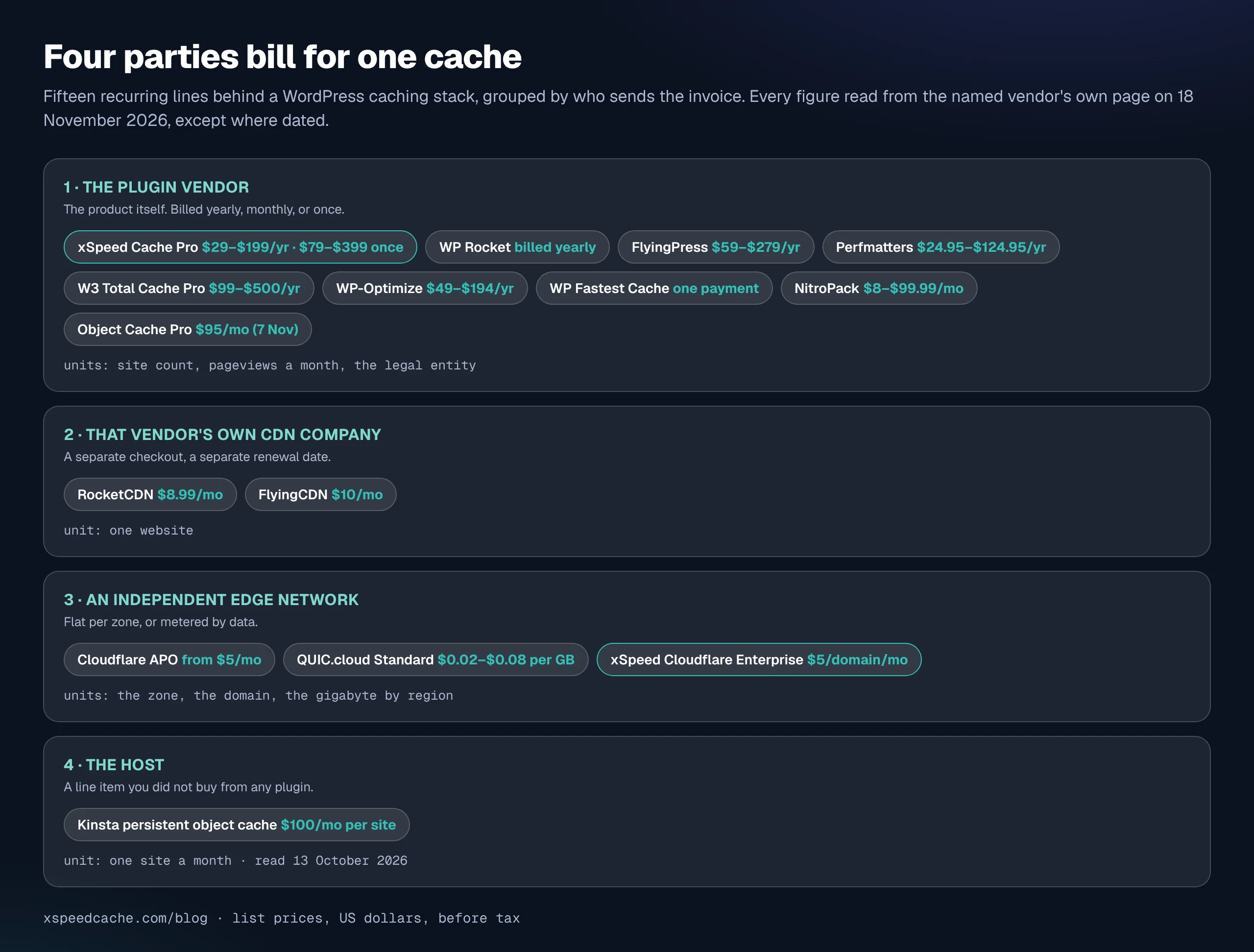
Every pricing comparison in this field, including three of our own, prices an annual licence for a plugin. That is not what caching costs. The bill is a stack: a licence, plus whatever you switched on afterwards, charged by up to four separate parties on units that do not convert into each other. This post counts fifteen recurring lines and names the unit on each one.
Quick Summary: What Recurs, and What It Is Counted In
| If you want… | Do this | Why |
|---|---|---|
| One site, one invoice a year | A plugin licence only, and no cloud add-on | Six of the seven plugin licences in this census bill yearly and nothing else recurs |
| One site, no invoice ever again | A one-time licence | Two products in this census sell one, and ours is one of them |
| Predictable cost as traffic grows | Flat per-site pricing, not metered | Per-pageview and per-gigabyte lines move with a traffic spike; a licence does not |
| The cheapest first year | A sale price, with year two written down first | Four of seven licence vendors are discounting today and three are not |
| An edge CDN in front of the cache | A flat monthly CDN, budgeted per domain | The three plugin-vendor CDNs here cost $5 to $10 a month per site |
| An object cache that someone supports | A monthly subscription, priced per entity or per site | The two supported options here are $95 and $100 a month |
Three numbers frame the whole census. The median plugin licence in it costs $99 a year. The most expensive single monthly line costs $1,950 a month. And $0.02 per gigabyte is the smallest unit anyone bills on, which is also the hardest to forecast.
The Smallest Line on the Invoice Is the One Everyone Compares
A caching comparison almost always ends in a table of licence prices. That table is accurate and close to irrelevant, because the licence is the only line in the stack that cannot grow. It is fixed in advance, it is billed once a period, and it is usually the smallest figure on the page.
What grows is everything bolted to it. Turn on an edge CDN and a second vendor starts billing monthly. Add a persistent object cache and either a subscription or a hosting line item appears. Outgrow a metered plan and the meter, not the licence, decides what happens next.
The three pricing posts already published here each take one slice of this. Our three-year licence comparison prices nine licences to year three. Our lapse census records what each vendor takes back when payment stops. Our licence-unit census found that WP Rocket counts domains while W3 Total Cache counts installations, and that the two answer the same scenario in opposite directions. None of the three asks the question below, and neither does anyone else: a scan of every heading in all 108 posts on this blog on 18 November 2026 returned exactly one that touches recurring cost, and it is a closing line rather than a section.
The Monthly-Bill Census: Fifteen Recurring Lines, Read 18 November 2026
Every cell below was read from the named vendor’s own page on 18 November 2026, except the two rows that carry their own date. Prices are list prices in US dollars, before tax.
| Line you pay | Who bills it | What recurs | How often | The unit | Price, 18 Nov 2026 |
|---|---|---|---|---|---|
| xSpeed Cache Pro | WPDeveloper (ours) | Updates and support | Yearly, or never on Lifetime | Site activations, per domain | $29 / $49 / $99 / $199 a year, or $79 / $149 / $249 / $399 once |
| WP Rocket | WP Media | Updates and support | Yearly, or three years upfront | The top-level domain | $5 / $10 / $25 a month shown, billed yearly |
| FlyingPress | FlyingPress | Updates and support | Yearly, automatic | Websites, 1 to unlimited | $59 / $109 / $229 / $279 a year after the first |
| Perfmatters | Perfmatters | Support and updates | Yearly, auto-renew at 15% off | One WordPress website | $24.95 / $59.95 / $124.95 a year |
| W3 Total Cache Pro | BoldGrid | The licence | Yearly | A WordPress installation | $99 (1 site) / $350 (5) / $500 (10) a year |
| WP-Optimize Premium | TeamUpdraft | Premium features | Yearly | Sites, 2 to unlimited | $49 / $99 / $194 a year |
| WP Fastest Cache Premium | WP Fastest Cache | Nothing recurs | One payment | The URL | Not published on the site today |
| NitroPack | NitroPack | The optimisation service | Monthly or yearly | Pageviews a month, plus CDN gigabytes and sites | $8.00 / $22.00 / $99.99 a month, or $7.00 / $18.00 / $83.01 billed annually |
| QUIC.cloud Standard | QUIC.cloud | CDN bandwidth past a free monthly quota | Monthly | The gigabyte, priced by region | $0.02 to $0.08 per GB |
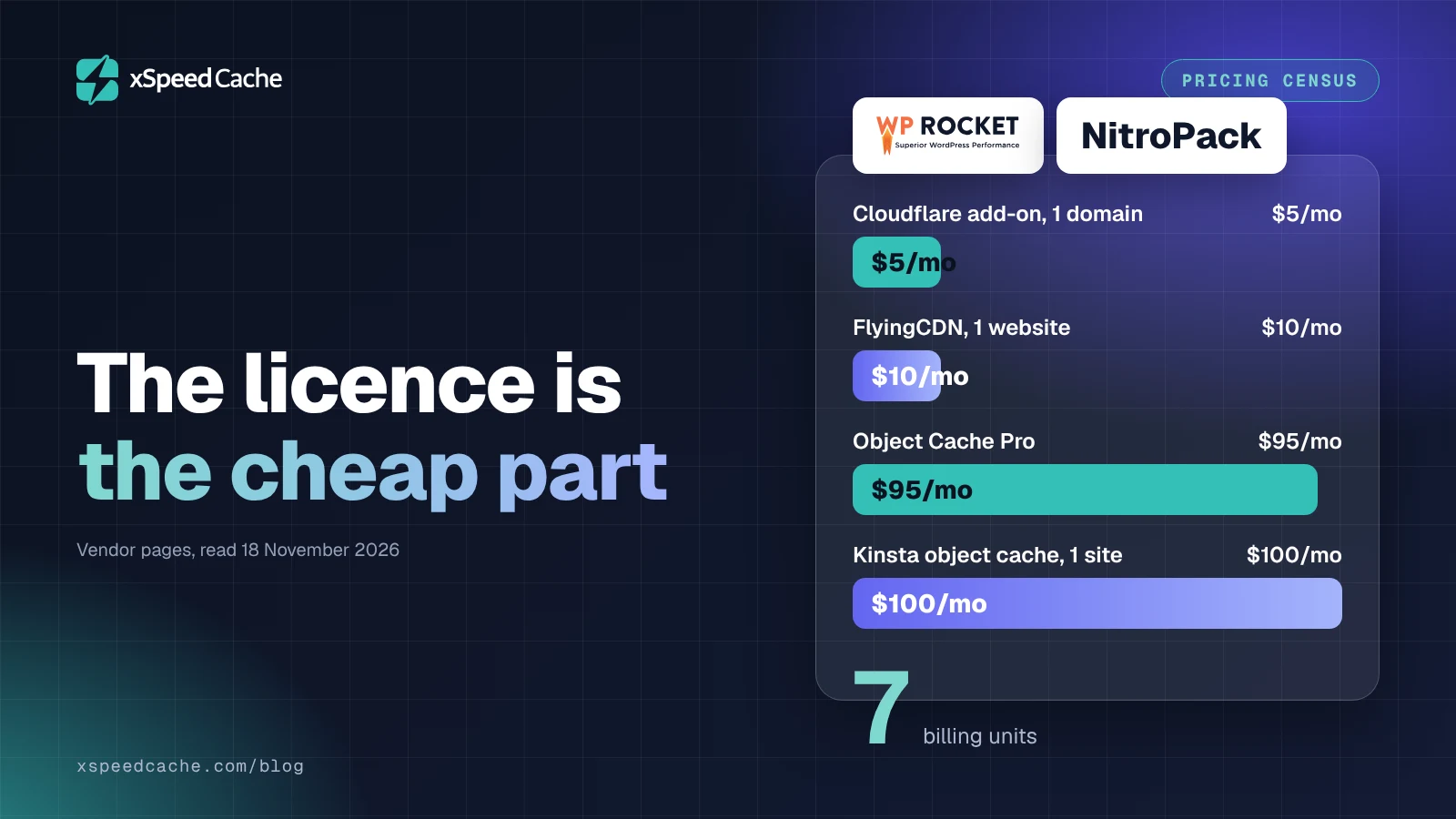
| Object Cache Pro | Object Cache Pro | The right to run it | Monthly or yearly | The legal entity, unlimited owned sites | $95 a month or $950 a year; Enterprise from $1,950 a month (read 7 Nov 2026) |
| RocketCDN | WP Media | CDN delivery, unlimited bandwidth | Monthly or yearly | The website | $8.99 a month, or $89.99 a year |
| FlyingCDN | FlyingPress | CDN delivery, 100 GB included | Monthly | The website | $10 a month |
| Cloudflare APO | Cloudflare | Edge caching of WordPress HTML | Monthly | The zone, on the Free plan | From $5 a month |
| Cloudflare Enterprise add-on | WPDeveloper (ours) | Whole-site delivery on Cloudflare | Monthly | The domain | $5 a month, billed separately |
| Persistent object cache | Kinsta | The object cache itself | Monthly | The site | $100 a month per site (read 13 Oct 2026) |
Two rows need their provenance stated rather than implied. Object Cache Pro could not be re-read today: objectcache.pro returned 403 to every request from this session, on the pricing page and the docs alike, and the browser route that worked in October was unavailable. The figures above are the last verified reading, taken on 7 November 2026, and they are printed with that date rather than presented as current. Kinsta’s figure comes from our own managed-hosting census, where Kinsta’s documentation was read on 13 October 2026, and it is quoted rather than re-derived.
The remaining thirteen rows were read the same morning from the publisher of each figure: WP Rocket, FlyingPress, Perfmatters, W3 Total Cache Pro, WP-Optimize, WP Fastest Cache, NitroPack, QUIC.cloud, RocketCDN, FlyingCDN and Cloudflare’s plans page.
Seven Units, Four Parties, and Why Two Prices Will Not Compare
Sorting the fifteen lines by what they are counted in produces seven units, not the two or three a comparison table implies.
| Unit | Lines billed on it | What makes it incomparable |
|---|---|---|
| Site count, yearly | 6 | The site is defined six different ways; a domain, an installation and a website are not the same object |
| Site count, one time | 2 | No renewal date exists, so no annual figure is comparable to anything else here |
| One website or zone, flat monthly | 4 | Cost scales with how many sites you run, and not at all with how busy they are |
| Pageviews a month | 1 | Cost scales with traffic, so a successful month is a more expensive month |
| Gigabytes a month | 1 | Cost scales with page weight and with how much of the world your audience is in |
| The legal entity, monthly | 1 | Unlimited sites for one price, so the per-site cost falls as you grow |
| One site a month, from the host | 1 | The charge appears on a hosting invoice, not on any plugin’s receipt |
The four parties are easier to miss than the seven units. A plugin vendor bills the licence. The same vendor’s separate CDN company bills delivery, which is why RocketCDN and FlyingCDN have their own checkouts. An independent edge network bills bandwidth or a zone fee. And the host bills whatever it has decided is an upgrade. Four invoices, four renewal dates, four cancellation paths.
The practical consequence is that a per-site figure and a per-pageview figure cannot be ranked against each other without a sample of your own traffic. One site at 300,000 views a month and twenty sites at 1,000 views each are the same pageview bill and a twentyfold difference in licence cost. Any article that puts those two products in one sorted column has chosen a unit for you and not told you which.
Who Prints a Price Per Month, and Who Actually Bills Per Month
The display unit and the billing unit come apart, and they come apart in both directions.
| Vendor | Price shown as | Actually billed | Monthly plan available |
|---|---|---|---|
| WP Rocket | Per month | Yearly | ❌ |
| NitroPack, annual column | Per month | Yearly | ✅ |
| NitroPack, monthly column | Per month | Monthly | ✅ |
| RocketCDN | Per month | Monthly or yearly | ✅ |
| FlyingCDN | Per month | Monthly | ✅ |
| Object Cache Pro | Per month | Monthly or yearly | ✅ |
| Cloudflare APO | Per month | Monthly | ✅ |
| Our Cloudflare add-on | Per month | Monthly | ✅ |
| FlyingPress, Perfmatters, W3 Total Cache, WP-Optimize | Per year | Yearly | ❌ |
| Our Pro licence, yearly | Per year | Yearly | ❌ |
Eight of the fifteen lines quote a monthly figure. Seven of those eight will take money monthly if you ask them to. The exception is WP Rocket, the only plugin licence in the field that advertises entirely in months and has no monthly billing at all. Its three pricing cards read $5, $10 and $25 a month, its Black Friday row reads $3, $6 and $15 a month, and the small print under both reads “Billed yearly. Price is valid for the 1st year.” A buyer comparing “five dollars a month” against NitroPack’s eight is comparing one annual charge of sixty dollars against a cancellable monthly one.
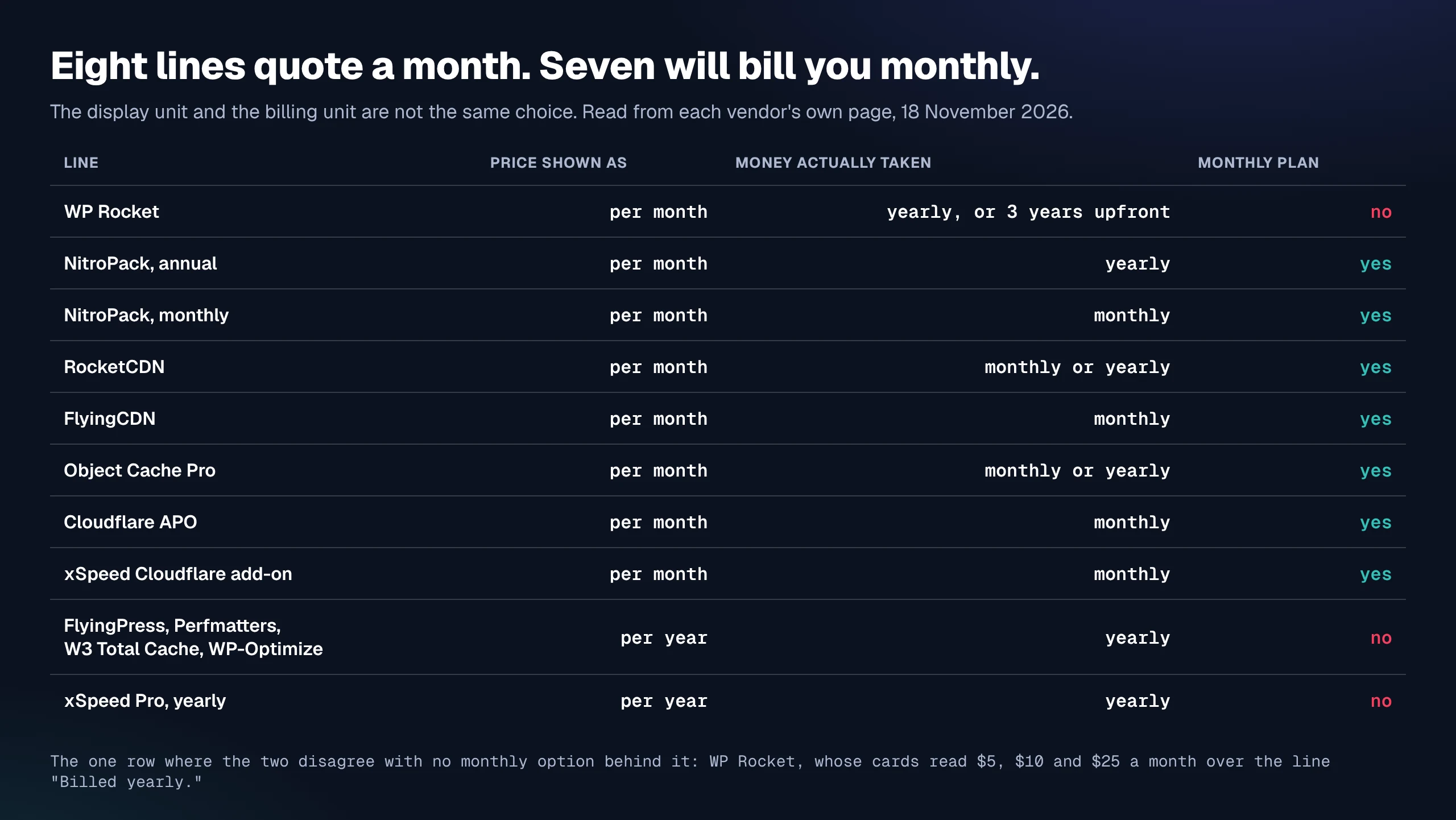
None of this is hidden, and WP Rocket’s own frequently asked questions are unusually direct about the consequence: “The Black Friday discount is applied when you buy WP Rocket for the 1st time. Once your initial license period ends, your license will renew annually at the regular renewal price.” The number is honest. The unit it is displayed in is a marketing choice, and it is the choice that makes the cheapest-looking line in this census belong to a product with no monthly option.
The Metered Lines: Pageviews, Gigabytes, and a Legal Entity
Three products in the census do not price a site at all.
NitroPack prices attention. Its plans include 1,000, 8,000, 40,000 and 540,000 pageviews a month, with 1, 5, 25 and 270 GB of CDN bandwidth alongside them, per its pricing page read today. Its own answer on exceeding those limits has two halves and both belong in any quotation of it: “If you exceed your plan’s limits, NitroPack will stop optimizing your site until the next billing cycle.” The same answer continues by offering “Resource Overages, which allows you to set a budget for additional resources”, and says this “ensures your site continues to be optimized without interruption.” With no overage budget set, running out of meter is a silent performance cliff. With one, performance holds and the invoice moves instead.
Two further lines on that page sit oddly together, read the same minute. Under extra fees: “No, NitroPack’s pricing is transparent, with no hidden fees. You only pay for the plan you choose, with no surprise charges.” Four questions later, Resource Overages exist precisely so that you can pay beyond the plan you chose. Both statements can be true at once, and a buyer reading only the first will be surprised anyway. The page also states “Downgrades are not available”, which on a metered product means a quiet month cannot be made cheaper, and gives a reason for having no one-time option: “NitroPack does not offer a lifetime license because site optimization isn’t a one-time task.”
QUIC.cloud prices data. LiteSpeed Cache is free in the WordPress plugin directory, and its edge work runs through QUIC.cloud, whose Standard Plan gives a free quota each month and then charges by region. Its own cost page, read today, puts that at “between 2 cents and 8 cents per GB in USD, depending on region”, with a regional table reading $0.02, $0.02, $0.04 and $0.08. A free plugin with a per-gigabyte tail is the one shape no licence table in this niche can show.
Object Cache Pro prices the company. Its licence covers unlimited sites “owned and operated” by one entity, which is the only unit in the census that gets cheaper per site as you add sites. At the figures verified on 7 November 2026 it is also the most expensive single line here, and our comparison of it against the free Redis drop-in counted what the money buys: 12 of its 49 documented options handle failure, against 3 of the free plugin’s 31.
When the Recurring Line Belongs to Your Host
The fifteenth line is the one no plugin comparison contains, because no plugin vendor sends it.
WordPress ships an object cache that does not persist. Its own developer documentation for WP_Object_Cache describes the class as non-persistent by default, so the cache is built and discarded inside a single page load unless a backend such as Redis or Memcached is wired behind it. That gap is a product opportunity, and several managed hosts price it. Kinsta’s documentation, read on 13 October 2026 for our host census, prices a persistent object cache at $100 a month per site, which is $1,200 a year for one website, billed by a company that also tells you a caching plugin is unnecessary on its platform.
Hosting is the half of performance a cache cannot fix, and a cache is only ever as fast as the server behind a miss. We recommend xCloud for that half, and it is ours: xCloud and WPDeveloper are both Startise companies. The point for this census is narrower than a recommendation. Before you price an object cache as a subscription, read what your current host charges for one, because that line may already exist on an invoice you are paying.
The Recurring-Line Audit: Five Minutes Before You Pick Anything
Every framework in this niche totals licence prices. This one totals renewal events, which is a different and more useful number.
- List every line that will bill you again. Licence, CDN, object cache, edge add-on, hosting upgrade. Write one line each, even the ones that are currently free.
- Write the unit next to each line, in the vendor’s own words. Not “per site”: “per top-level domain”, “per WordPress installation”, “per 40,000 pageviews a month”, “per gigabyte by region”.
- Multiply by the unit you actually have. Count your domains, your installations, your pageviews last month and your egress last month. Use real figures from your own analytics, not a plan you hope to grow into.
- Add a renewal date column. Four parties mean four dates. A stack that totals $40 a month with three renewals in different weeks is harder to manage than one that totals $55 on a single date.
- Score the worst month, not the average. For every metered line, price the busiest month you have had in the last year. That figure, not the list price, is your exposure.
The limitations are real and worth stating. This protocol prices nothing a vendor does not publish, so a product that keeps its premium price behind a dashboard, as WP Fastest Cache does today, cannot be audited from outside. It uses last month’s traffic as a predictor, which fails exactly when a post takes off. It ignores your own time, which the three-year comparison argues is the largest uncosted line in the whole stack. And it is a snapshot: our own term-volatility study re-read nine pricing pages on seven dated occasions and found ten changes, so any audit has a shelf life measured in weeks.
Pricing the Stack Across Twenty-Five Client Domains
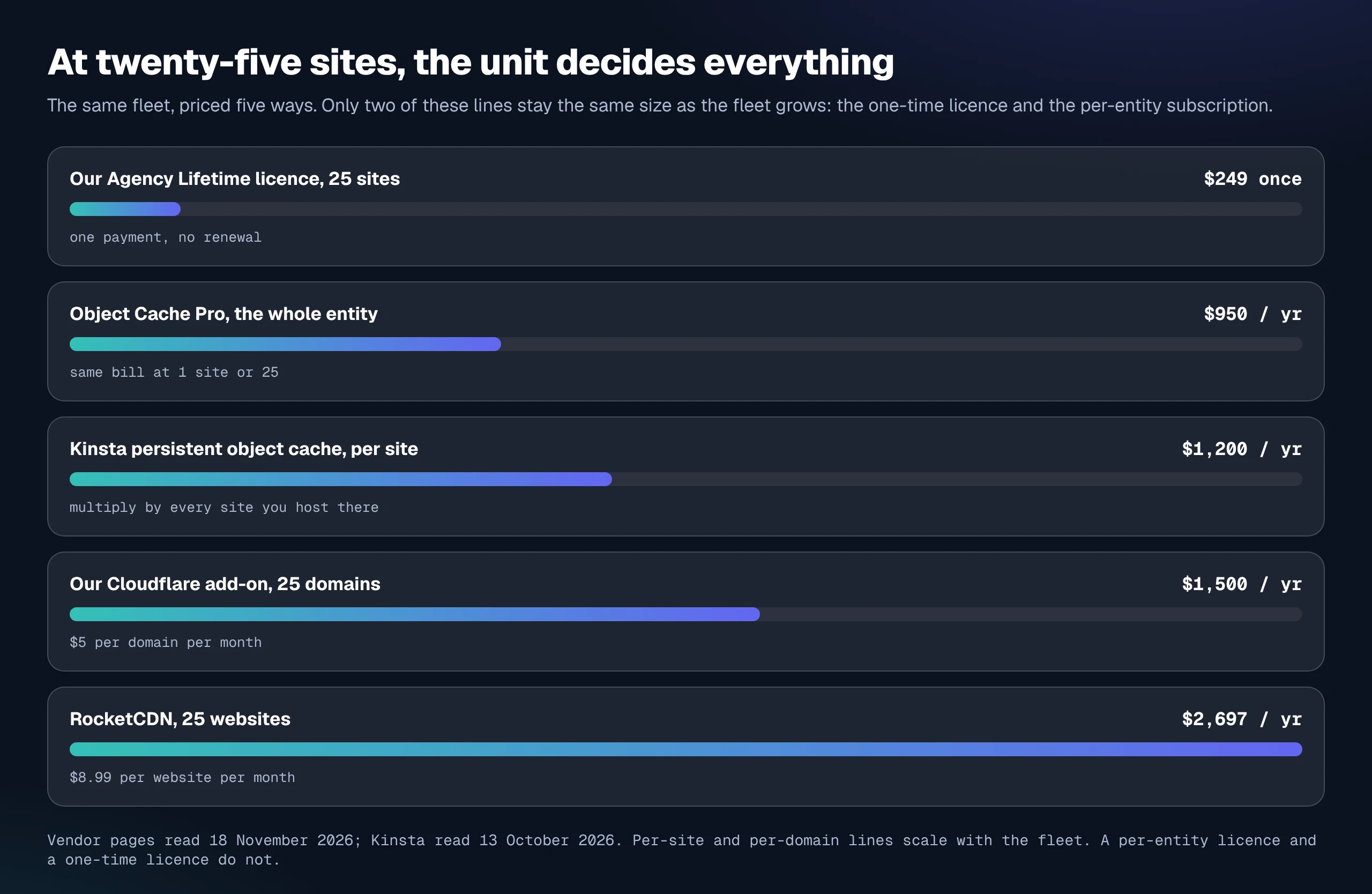
At one site the arithmetic is a nuisance. At twenty-five it is the whole decision, because every unit in the census behaves differently when multiplied.
Take the same twenty-five sites through four of the census units:
- 📈 Flat per-site monthly CDN at $8.99: $2,697 a year, rising in a straight line with every site you add.
- 🏢 Per-entity object cache subscription: one bill, whatever the count, so the per-site cost falls as the fleet grows.
- 📊 Metered pageview plan: unpredictable by design, because one client’s product launch moves the invoice for all of them.
- 🔢 A licence priced per installation rather than per domain: the count changes again as soon as a client runs a subdirectory multisite.
Our own Agency tier covers 25 site activations at $99 a year, or $249 once on a Lifetime licence, and every Pro feature ships in every tier, so the smallest plan runs the same engine as the largest. Our Cloudflare Enterprise add-on is the line to watch in that configuration, and the arithmetic belongs here rather than in a footnote: at $5 per domain per month, twenty-five domains is $1,500 a year on top of a $249 one-time licence. Six times the licence, every year, which is the shape this whole census is about. xSpeed Hub and the MCP server are in every tier at no extra charge, which keeps fleet management off the recurring list, and agencies are the audience that feels the difference first.
Run the free scan on your own site before pricing anything: xspeedcache.com/scan/
What We Charge, and the Line Our Own Page Does Not Print
Until this year we could say that nothing we sell recurs monthly. That is no longer true, and the honest version of this census puts our rows in the same columns as everyone else’s.
We bill three ways, all read from our pricing page today:
- 🗓️ A yearly licence at $29, $49, $99 or $199 by site count, discounted 50% from $58, $98, $198 and $398.
- 🏷️ A one-time Lifetime licence at $79, $149, $249 or $399, with no renewal at all, discounted 50% from $158, $298, $498 and $798.
- 🌐 A monthly add-on, Cloudflare Enterprise at $5 per domain per month, billed separately, with its own licence key, and requiring a paid plan on either ladder.
Here is where we come second, and it is specific. Our page does not say what a yearly licence costs in year two. It says “Billed annually, cancel any time”, it says Lifetime has “no renewal, no second invoice, ever”, and it is explicit that Black Friday lifetime pricing is limited. It never states that a $29 Personal year renews at $58. WP Rocket prints “Price is valid for the 1st year” on every card and explains the renewal price in its FAQ. FlyingPress prints “First year after trial, then $59/year” directly under the sale figure. On this single axis their pages are clearer than ours, and a buyer who needs year two in writing before committing is better served by either of them today.
Two more entries on our own Cons list. Our plugin carries 10,000+ active installs and 29 ratings on the wordpress.org plugin directory, queried directly on 18 November 2026, against LiteSpeed Cache’s seven million: a short public record next to a long one. And the add-on above means we now have the same thing we have spent three posts pointing out in other vendors, which is a second invoice from a second counter.
Reading a Price in Sale Season
A census taken on 18 November 2026 has a problem worth printing rather than hiding: four of the seven plugin licences here are discounted today and three are not.
| Vendor | Sale today | Page states year two | Regular figure visible |
|---|---|---|---|
| WP Rocket | ✅ 40% to 60% off | ✅ | ✅ |
| FlyingPress | ✅ Black Friday | ✅ | ✅ |
| xSpeed Cache (ours) | ✅ 50% off | ❌ | ✅ struck through |
| Perfmatters | ❌ | ✅ 15% renewal discount | ✅ |
| W3 Total Cache Pro | ❌ | ❌ | ✅ |
| WP-Optimize | ❌ | ❌ | ✅ |
| WP Fastest Cache | ❌ | ❌ | ❌ |
Comparing a discounted first year against an undiscounted list price ranks the field by who is running a promotion in the third week of November. The fix is one column, not a different table: write down what each line costs the second time it bills, and compare those. WP Rocket’s three-year option makes the same point from the other side, since paying three years upfront is a bet that the regular renewal price will be higher than the locked one.
Sales also move faster than any article. Our hub on choosing a caching plugin and the 80-capability comparison both carry fetch dates for the same reason, and Free vs Pro lists which features sit behind a licence at all, which is the question underneath every price on this page.
Common Mistakes Buyers Make When Pricing Caching
- 💡 Comparing a monthly display price to a monthly charge. Eight lines here quote a month. One of them, WP Rocket, will not bill you monthly under any circumstances.
- 📊 Pricing a metered plan on an average month. Price the busiest month instead. A plan that fits eleven months of the year and stops optimising in the twelfth has failed at the moment it mattered.
- 🧾 Forgetting the CDN has its own checkout. RocketCDN and FlyingCDN are separate purchases from the plugins they belong to, and neither appears on the licence invoice.
- 🏠 Pricing an object cache without reading the hosting plan. One host in our census charges $1,200 a year per site for the thing a $0 plugin configures, and another includes it.
- 🔁 Treating a one-time licence as free forever. It removes the renewal, not the stack. A Lifetime licence with a $5 monthly add-on on twenty-five domains still bills $1,500 a year.
- 📅 Counting invoices instead of renewal dates. Four parties mean four dates, four cards on file and four places a failed payment can switch something off.
Frequently Asked Questions
My caching plugin cost $59 a year. Why is my card charged every month?
Almost certainly a second line. The three most common are a CDN from the same vendor on a separate subscription, an edge add-on such as Cloudflare’s Automatic Platform Optimization on the Cloudflare account rather than the plugin’s, and a hosting upgrade. Check which company the charge is from before you look at the plugin at all, because four different parties bill into one stack.
I bought a one-time licence. Can anything still bill me?
Yes, and this census contains two examples. A one-time licence ends the renewal for the plugin only. Our own Cloudflare Enterprise add-on is $5 per domain per month next to a Lifetime licence, and a CDN or object-cache subscription is unaffected by how the licence was bought.
My NitroPack site stopped being optimised halfway through the month. What happened?
The meter ran out. NitroPack’s own answer is that exceeding plan limits stops optimisation until the next billing cycle, unless Resource Overages are configured with a budget, in which case optimisation continues and the invoice grows instead. Both halves of that answer matter, and the default is the first one.
I pay for an object cache subscription and my host also charges for Redis. Am I paying twice?
Possibly, for different things. A host charge usually buys the Redis or Memcached instance and its persistence. A subscription such as Object Cache Pro buys the drop-in that talks to it, plus support and its failure handling. Read our comparison with the free drop-in before paying for both, because the free option reaches the same backends.
My CDN invoice is larger than my plugin licence. Is that normal?
It is the common case rather than the exception. A flat CDN here runs $8.99 to $10 a month per website, which is $108 to $120 a year against licences starting at $24.95. On a per-gigabyte plan the ratio depends on page weight and audience geography, which is why step five of the audit above prices the worst month.
Which of these products will actually take money monthly?
Seven of the fifteen lines: NitroPack, Object Cache Pro, RocketCDN, FlyingCDN, Cloudflare APO, our own Cloudflare add-on, and a host’s object-cache line item. Every plugin licence in the census bills yearly or once, whatever period its page displays.
Does a free caching plugin ever create a recurring bill?
It can. LiteSpeed Cache is free in the plugin directory, and its edge service QUIC.cloud charges beyond a monthly free quota at 2 to 8 cents per gigabyte by region. The plugin stays free; the delivery does not.
Why does WP Rocket show a price per month if it bills yearly?
Only WP Rocket can answer the why. What its page states is unambiguous: three cards priced per month, “Billed yearly” underneath, “Price is valid for the 1st year”, and a renewal at the regular price once the initial period ends. Multiply the monthly figure by twelve before comparing it to anything that genuinely bills monthly.
Can I move from a monthly plan to a yearly one, or back?
Upward, usually. Downward, sometimes not: NitroPack states plainly that “Downgrades are not available.” Our own ladder allows a move up at the prorated difference and a switch from Yearly to Lifetime with credit for an active term, arranged with support before purchase. Check the downgrade answer specifically, because it is the one most pricing pages leave out.
I am trying to compare two products and the prices will not line up. What now?
They are probably on different units. Convert both to the unit you have most of, which for one site is a year and for an agency is a domain. Our licence-unit census covers the harder half of that conversion, where one vendor’s site is another vendor’s installation.
What is the shortest version of the audit?
Add up only what will bill again, name the unit on each line, multiply by what you actually have, and price your busiest month. If the total surprises you, the licence was not the problem.
Conclusion: Add Up What Recurs Before You Pick a Plugin
Fifteen recurring lines, seven units, four parties, and the line everyone compares is the one that cannot grow. The field is not being evasive about this. Every figure in this post came off a public page, most of them in a single morning. The prices are simply counted in units that do not convert, and the comparison nobody publishes is the one that converts them.
| If your situation is… | The honest pick | Why |
|---|---|---|
| One site, want zero recurring lines | WP Fastest Cache Premium, or our Lifetime licence | The only two one-time options in the census |
| One site, want year two in writing before buying | WP Rocket or FlyingPress | Both print the renewal price under the sale figure; our page does not |
| High and spiky traffic | A flat per-site licence, not a metered plan | A metered plan prices your best month highest |
| An agency with 25 or more domains | A per-entity or per-site-count licence, and a hard look at per-domain add-ons | Per-domain monthly lines multiply; a licence does not |
| A fleet that needs a supported object cache | Object Cache Pro, or a host that includes one | Priced per entity, so the per-site cost falls as you grow |
| Want the cache and the add-ons from one counter | xSpeed Cache Pro, which is ours | One licence, every feature in every tier, and the one monthly line is optional |
What to do this week: open your last three card statements and list every line that touches website performance. Write the vendor’s own unit beside each one. Multiply by the domains, installations and pageviews you actually have, then price your busiest month. Look up what your host charges for a persistent object cache before buying a subscription for one. If the stack is heavier than it should be, our Pro licence starts at $29 a year or $79 once at the current discount, with a 14-day money-back guarantee and a 14-day free trial before that.
And if year two in writing matters more to you than anything else on this page, WP Rocket and FlyingPress both print it and we do not. That is a fair reason to buy from either of them, and we would rather say so here than have you find out in twelve months.
If you have a recurring performance line we missed, the comments are the right place for it. A census is only as good as the invoices people are willing to describe.